




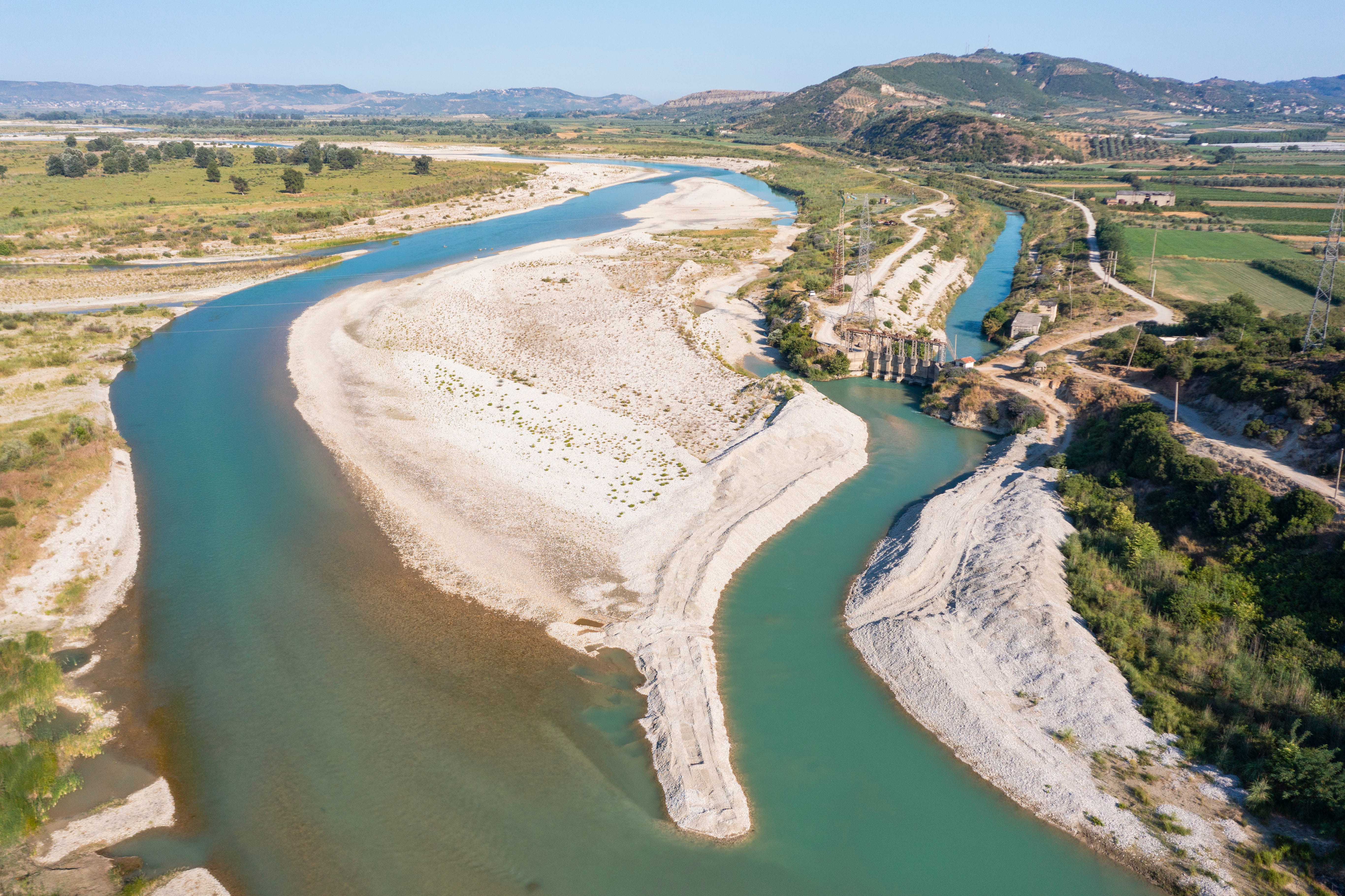
As we celebrate the third anniversary of the Vjosa Wild River National Park, a study released today by Hauer Hydraulic (Austria) and M&K Consulting (Albania), commissioned by Riverwatch and EuroNatur, warns that the "Wild River" is facing an invisible crisis: massive water abstraction. While the Vjosa remains one of Europe's last free-flowing river systems, human demand for water abstraction (i.e. for irrigation) is increasingly straining this lifeline.
The summer low-flow crisis
The report’s most alarming finding concerns the river’s survival during the dry summer months. In August 2025, during typical low-flow conditions, the Vjosa’s discharge near Poçem was measured at approximately 20 m3/s. Shockingly, the study found that only two of the five major irrigation channels, including the Levan-Fier Canal, were extracting roughly 9 m3/s.
This means that about 50% of the Vjosa’s total flow was diverted for agriculture during the year's most vulnerable period. This massive extraction within the national park is a clear violation of the IUCN Category II National Park standards and a blatant breach of the UNESCO Biosphere Reserve rules, which are designed to prioritise ecosystem integrity over industrial and agricultural exploitation.
Key findings
- The report surveyed 20 key abstraction points, including 5 irrigation channels, 10 underground/spring water stations, 3 pumping stations, and 2 hydropower plants.
- Water abstraction is one of the biggest pressures and threats to the Vjosa Wild River National Park.
- Irrigation channels, particularly in the lower Vjosa, were identified as having the strongest impact on wetted areas and vital instream habitats. For instance, the Levan-Fier Canal can take in up to 8 m3/s via a provisional embankment built across the riverbed every year.
Protecting the Vjosa's future
Ultimately, the report delivers a sobering verdict: water abstraction is one of the greatest threats to the Vjosa Wild River National Park. The data from August 2025 reveal that abstraction rates have already reached a breaking point, violating the strict IUCN category II criteria required to maintain its status as a national park.
Crucially, the current Management Plan for the park provides a clear roadmap for protection: it mandates a total ban on any new water abstractions and requires that all existing water abstractions be phased out and stopped within the next 15 years. As Europe remains the fastest-warming continent, intensifying droughts will only sharpen the conflict between human demand and ecological survival. The study emphasises that without a transparent legal process and rigorous monitoring, we face a very real question: What is a Wild River National Park with only half of its water? If the river’s lifeblood continues to be drained at this rate, the "Wild River" designation risks becoming a title held by a dry bed.
